(Graphite)
We publish this open letter from someone with a previous association with Australia’s Marxist-Leninist organisations. We protect his identity.
Comrades,
I write to you as someone who shares your unease, and your anger, at the corrosive effects of contemporary capitalism on working people, on communities, and on the dignity of labour. Like many of you, I once looked to Marxism not as a dogma but as a tool, a way of understanding power, and of imagining a social order in which economics served the people rather than the other way around.
I have not abandoned that concern. What I have abandoned is the belief that capitalism today can be confronted using the same assumptions, categories, and reflexes that shaped revolutionary politics a century ago, or even half a century ago. Capitalism has changed, radically. If our critique does not change with it, we risk fighting ghosts while the real enemy carries on largely unopposed.
– Capitalism Is Now Fully Global, and Fully Cultural
The capitalism we face today is not just a system of ownership and profit extraction. It’s global, post-national, and civilisational. It dissolves borders when they constrain the movement of both capital and labour. It treats nations, cultures, and peoples not as living communities but as interchangeable markets and labour pools.
In opposing this system, it’s unhealthy, and ultimately self-defeating, to adopt its underlying premises. Chief among these is the idea that humanity must converge toward a single global monoculture, one economic model, one moral vocabulary, one set of acceptable identities, endlessly managed by transnational institutions and corporate power.
Culture is not an “illusion” that simply masks class relations. It’s the medium through which real people live, work, and understand solidarity. The erasure of culture, including the culture of foundational Australia, is not a side-effect of global capitalism; it’s one of its core mechanisms. A people stripped of memory, place, and shared story is easier to manage, easier to divide, and easier to dispossess.
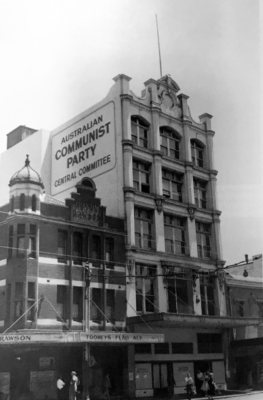
– Looking Outward While Australia Burns
It’s striking, reading Australian Marxist-Leninist newspapers and statements, how much attention is directed overseas, toward Palestine, the Middle East, the crimes of US imperialism, and the struggles of distant peoples. Much of this analysis is morally serious, and often correct. Still, it raises a fair question. Who, exactly, is fighting for the Australian working class here and now?
Australia is not merely a bystander to global capital. It’s a developed country that has been steadily hollowed out, deindustrialised, financialised, and demographically reshaped in the interests of profit. Wages stagnate, housing becomes unreachable, communities fracture, and public assets are sold off, yet the centre of gravity of left politics remains elsewhere.
If global capital can be confronted and restrained in a country like Australia, if a developed nation can show that a communitarian economy can coexist with real cultural independence, then developing countries will be far better placed to resist exploitation themselves. An Australian example, grounded in sovereignty and social cohesion, would be worth more than a thousand editorials about conflicts we cannot materially influence.
– Nationalism and the Old Labor Tradition
Australian nationalism, as I understand and advocate it, is not an import. It’s the modern continuation of the Old Labor tradition, the strand of Australian socialism that understood economic justice and national self-determination as inseparable.
This tradition, associated with figures such as Lang, Spence, Lane, and Curtin, was protectionist, communitarian, and deeply suspicious of international finance. It understood that a working class without a country is a working class without leverage. It sought independence not to dominate others, but to govern ourselves.
This bears no resemblance to neo-Nazi cults of German ethnic chauvinism or imperial ambition. Australian nationalism does not seek racial empire or biological hierarchy. It seeks democratic control over our economy, our borders, and our political destiny. It affirms the right of all peoples to independence, including white Australians, who are routinely told that their claims to continuity and belonging are somehow illegitimate.
– Socialism Was Never One Thing
Marxism itself, when taken seriously, teaches us that socialism is not a single frozen form. Over the twentieth century it evolved as it encountered real nations, real histories, and real conditions.
From Lenin’s internationalism to the nationally specific paths forged by Ho Chi Minh, Tito and Castro, the trajectory of socialism, until its derailment in 1991, was toward rooted, sovereign social economies.
These were not abstract class experiments; they were national projects, shaped by culture, memory, and popular legitimacy.
Many Australian nationalists seek a communitarian economy for precisely this reason. There can be no real, lasting national solidarity while economic classes are locked in permanent contention. A society endlessly divided between winners and losers, asset-holders and renters, insiders and the displaced, cannot sustain either socialism or democracy.
– Why This Letter Is Addressed to You
This letter is addressed to Marxist-Leninists because, unlike the Trotskyist parties, you have not entirely surrendered to liberal-bourgeois ideology dressed up as radicalism. You still speak, at least in principle, of class, production, and material power.
The Trotskyist fixation on niche lifestyle politics and ever-expanding sexual and identity subcultures does not attract working Australians; it drives them away. It fragments solidarity and pulls attention from the central struggles of our time.
Those struggles are not abstract. They are the economic dispossession of working Australians by global capital, and the profound demographic transformation of the nation, also driven by capital and enforced by its local managerial class. These are not “culture war distractions”. They are the lived reality of millions of people watching their country slip out of their hands.
– A Choice of Relevance
The question before Australian Marxist-Leninists is not whether capitalism should be opposed. On that, we agree. The real question is whether you will oppose capitalism as it actually exists today, or as it existed in pamphlets written for a different world.
A left that cannot speak for its own people will not liberate anyone. A socialism that cannot coexist with national continuity will never command mass loyalty. A movement that treats culture as expendable will always be outflanked by forces far more cynical, and far more dangerous.
There is still space for dialogue. There is still space for a serious, grounded Australian radicalism that resists global capital without dissolving the nation in the process. I invite you to consider whether that path, rather than permanent opposition from the margins, is one worth taking.
In solidarity,
Graphite
An Australian nationalist who never stopped opposing capitalism, only outdated ways of understanding it.