Nick Griffin examines the career of a proven state agent
WHY SHOULD Australians be interested in the announcement of the death of a middle-aged Brit with a long record of involvement in the British Nationalist scene? Because the intelligence services of Oz and the UK share the same liberal obsessions and distinctly totalitarian instincts and tactics.
And because Steve Blake, one of the most clearly compromised System operatives in the recent history of the UK’s “far-right” was — right up to the announcement of his death — closely involved with the UK’s main allies and supporters of another Five Eyes honeytrap, the National Socialist Network (NSN) [now the White Australia Party (unregistered)] and its leaders, Thomas Sewell and Joel Davis. So, who was Steve Blake, and how am I qualified to write about and judge him?
For a start, I’d known him longer than anyone else in the entire nationalist movement; we first met back in 1976 or early ’77, when he joined the local branch of the National Front (NF) in Ipswich, Suffolk, where I served as Secretary.
Steve Blake was about 14 years old at the time, three or four years younger than me. He was intelligent, keen and brave – he lived with his parents on a city council estate already suffering serious West Indian enrichment, and his school was dominated by leftists. He was threatened and bullied, but undeterred.

Steve Blake, contemplates life as an unloved oil painting
In the early 1980s, just after I left university, Steve began studying at Scotland’s St. Andrew’s University. We stayed in touch, though he drifted away from the NF, increasingly influenced by the considerably more openly extreme National Alliance of Dr William Pierce. He established Aurora Publications, importing and selling copies of Pierce’s The Turner Diaries.
Then, without a word, he disappeared. The far-left magazine Searchlight recently claimed that he joined the British National Party (BNP) under John Tyndall and remained active in Scotland, but no-one in the party up there had any recollection of him during that period.
In truth, it was nearly twenty years until he surfaced again, emailing me out of the blue in 2001, shortly after I became BNP leader.
Blake told me that he had vanished from the scene after suffering a nervous breakdown but was still a committed nationalist. He had become experienced with computers and wished to be involved again. He also said that he would understand if I was reluctant to allow him into the BNP after his episode of mental illness.
Shortly after, we spoke at length on the phone. I told him that if he was well now, and confident about withstanding the strains that might arise due to his re-involvement, he would be welcome.
Soon after that, he informed me that he was passing through my neck of the woods on some Web-related business. We agreed to meet for a chat over a lunchtime pint. Quite early into that meeting, he told me that he’d heard I was keen on folk music. So was he, he claimed. He handed me a home-recorded cassette tape of tracks by what he said was his favourite band, Wolfstone, a Celtic rock group from Inverness (not to be confused with the Irish Republican Wolf Tones). I liked the music and often played it while driving all over the country to speak at meetings. Remember this tape, it’s important!
Blake went to pains to stress his advanced computer skills and that, being self-employed, he was free to help at any time. This proved convenient because, soon afterwards, our previous main tech man allied with a group of civic nationalist plotters who, among other things, illegally copied the party membership list. Predictably enough, I turned to Blake, reassured that, as an old hand, I could trust him implicitly.
Within a short time, he was helping me personally with computer issues, as well as becoming an invaluable techie at the very heart of the BNP’s administration and organisation. He lived in Scotland for most of those years, so we rarely met in person, but maintained regular contact online and by phone.
On one occasion when we did meet, I quoted to him a line from a Wolfstone track on the tape. He asked what it came from, and I reminded him of the band’s name. However, he looked at me blankly, and said he’d never heard of them.
I thought it odd, but as we had much to discuss, I let it pass.
Early in 2006, I was due to appear in Leeds Crown Court on Race Act charges, with Mark Collett as my co-defendant. Two days before the trial, the head of our security team rang me. He said that Collett’s arrogance and various failings meant he and his team would only provide me with security during the trial, but not Collett…
By early 2008, Mark Collett’s arrogant treatment of many party stalwarts, and bad behaviour in various ways, came to a head. Blake, who had stayed loyal during a crisis in January 2006 in which Collett again was the cause — or at least the excuse for — the tensions and division, now sided with the ‘rebels’.

Mark Collett rides the town bike
The trouble was led by the Scot who had for several years been the head of our national admin, and as such entrusted with our membership list, Kenny Smith (the same one who now runs the Homeland Party).
Smith was catapulted into a key role in our administration and finances back in 2000, when the BNP was comprehensively debanked. Over the course of a few devastating weeks, we had well over a hundred bank accounts shut down. Local, regional and national, they were all lost. All except two, which were somehow overlooked and left active. Both were run by the same man – Kenny Smith.
Smith went overnight from being a minor player in the party to a vital lynchpin. The BNP’s finances were totally centralised, with one of his accounts being used for central party funds, the other for regional and local expenses.
For some years, the system worked very well. It made it much easier for the party to comply with the rigorous demands for oversight and accountability of the Electoral Commission. But it made Smith a powerful figure, and his attempt to exploit that power became a considerable threat.
The rebels only had one demand: that I sack Collett. He was central to the publicity side of our operation and, to be fair, popular among many in the party who had seen only his good side and heard his speeches.
I refused, since Collett had already faced a disciplinary tribunal, for the only possible breach of the party’s rules (being an arrogant weasel and upsetting people being a personality flaw, but not a disciplinary offence).
The tribunal investigated the much-hyped incident in which Collett and Dave Hannam had met two girls in Blackpool during a BNP conference and taken them back to their hotel room, only to ask them to leave after learning both were just fifteen. The tribunal had been headed by a close friend of Smith. Although he was deeply hostile to Collett personally, the fact that they broke no law — and that, to be fair, the two men, only in their mid-twenties, had done the right thing when they found that the girls were below the age of consent — led to Collett being issued with a final written warning.
This was not enough for the group using Collett as the excuse for trouble. I explained to Smith and his allies (a small but important group of young officials very much part of our organisational structure) that I couldn’t arbitrarily expel anyone, that proper procedure had and must be followed.
To my shock and sadness, Blake joined them, even though the campaign of disinformation and disruptive whispers in which they were patently engaging was starting to disrupt our preparations for the European elections due in June 2009.
Together, the rebel group came to me and demanded that, unless I sacked Collett immediately they would go on strike and paralyse the party.
As a matter of fact, I thought it quite likely that Collett would, in due course, do something else stupid and trigger his expulsion. However, I was also aware that to give in to such blackmail would make Smith & Co the de facto leadership. It would also unleash pressure from Collett’s supporters in the other direction and, since many other officials had only seen his charming and helpful side, they too made a powerful bloc in the party. The result would not so much be a split as a civil war.
Smith played one final card: As our units and donors poured money into savings for the coming Euro Push, our general income for the normal running of the party had dropped. Smith and his wife had the task of running the printer and packing machine which produced the party’s members’ bulletin, British Nationalist, which was posted monthly by snail mail to all members.
Even in those days, the cost was massive, but it was a vital part — not just of our internal communication — but also of our membership retention strategy.
I knew we had a shortfall in the money needed to post out thousands of bulletins, but Smith had said to leave it to him. He now revealed that, for months, they had only gone out because of a friend he had inside the Royal Mail Franking Depot. This friend took in our mailsacks out of hours and franked them without us paying for the service.
“You can’t afford to get rid of me”, he gloated. “You already owe the Royal Mail more than £20,000 and without my contact you won’t be able to afford to pay for any more BNP mailings”.
I called his bluff and the row exploded into a full-on split. As the struggle turned to bitter factional warfare, members of BNP’s security retrieved a party computer which had been lent to key Smith and Blake ally Sadie Graham. This gave us a treasure trove of intelligence, as it not only provided access to old emails but also to recordings and transcripts from the rebels’ frequent Skype meetings.
Among other eye-openers, we discovered that Blake had been using the little electronic monopoly he had built, to spy on the party email accounts of the entire organisation: snooping on all of us and feeding information about tensions, disagreements and plans to the rebel group, who used all this private information to identify and exploit weak points.
Had it gone on much longer without us finding out what was happening, the so-called December Rebels would have torn the BNP apart.
Our publication of this material led to an instant collapse in support for the rebels’ lies and the subversion they created. We secured a court order to stop the rebels using the membership list and prised Smith’s fingers from the levers of the party machine. The crisis was soon over, although the rebels vexatiously published the stolen membership list on Wikileaks, exposing many members to intimidation, vandalism and persecution.
While the party recovered, the hits to morale, organisation and fundraising did a great deal to aid Nigel Farage and UKIP pull off a last-minute revival from their own internal woes and score a record tally of European Parliament seats, during which they cut our realistically expected four or five seats to just two. Obviously, this was so massively convenient to the UK elite that one must assume it was no accident or coincidence.
Once we really started looking and digging, for example, we found serious questions over the bona fides of Sadie Graham, who in hindsight had been strangely boosted by the insistence of her Labour MP that she was such an unusual and good person that it was appropriate to pause the ‘No Platform’ policy of decades and have a friendly debate with her.
Graham and her boyfriend, Matt Single, were the ones who leaked the BNP membership list.
But of all the troublemakers who came within a whisker of stopping the BNP’s biggest ever breakthrough, the only two whose fake nature is known for certainty are Smith and Blake.
Smith was exposed because someone gave him more than £20,000 to make himself indispensable to me and the BNP. We knew this undisputably for, as soon as I learned of the huge amount we owed the Royal Mail, I contacted their regional manager to explain that we had just discovered that a bent employee had been stealing our mailshot money while having the bulletins sent for free of charge, for around a year.
My aim was to establish that the BNP was a victim rather than a perpetrator, and to position us to negotiate the phased payment of the huge sum we owed them.
A few weeks later, the manager contacted me to say that they had investigated the BNP franking account which Smith ran. He maintained that they ran rigorous checks to ensure that rogue employees could not frank the mail if the bills were not paid in time. He also said that every BNP postage bill had been accounted for! We didn’t owe them a penny.
Smith and his wife lived in a cheap little flat, with no income apart from their very basic BNP wage. He didn’t pay the rent, the BNP didn’t pay, so, who did? No doubt the same people who ensured that by closing all other party bank accounts Kenny Smith gained oversight of the BNP’s entire financial structure. That’s a vast trove of intelligence, bought and delivered by clout and funding way above the capacity of any opponent to deliver, save the State’s own intelligence service.
Only one conclusion was and is possible: Kenny Smith was and is an MI5 agent. As an aside, so was the membership secretary of Mosley’s British Union, and the capture of such boring, unglamorous but intelligence goldmine positions is a known and very understandable tactic for such bodies.
What about his close friend and factional ally Steve Blake? His actions in the BNP – and again when Mark Collett mysteriously put both his one-time bete noire in charge of Patriotic Alternative – also shout ‘intelligence operative’.
But is there a smoking gun, some fact which takes us beyond conjecture and likelihood into certainty?
Yes. Remember that cassette tape. Just as some agency decided to make Smith the only candidate for handling all the BNP’s money, so some agency decided to insert Blake into the BNP in 2000, where they ran him as an informer and sleeper for over seven years. The length of time pretty much rules out the Police, who rarely leave undercover officers in target organisations for that long, in case they go native.
That leaves the Zionist/left, Searchlight, Hope not Hate, or MI5. To be fair, either could have found Blake, long after his presumed change of heart near the end of his time at university.
While he never revealed any hint of homosexuality in either his NF or BNP days, rumours swirled about while he was in PA strongly suggesting that Steve Blake rejected hard-line nationalism when he decided he was ‘gay.’
Perhaps that constituted the mental breakdown of which he told me, or perhaps it was as fictional as his claim still to be “one of us”. It is likely, in either case, coming to terms with his own sexuality led the young, genuinely nationalist Steve Blake to reject his former ideals and emerge as a born-again liberal – the ideal candidate for a high-level infiltration operation to disrupt, monitor and mislead the ‘far-right’.
What is 100% certain is that whoever briefed him on his mission to infiltrate the BNP and worm himself into my confidence had studied me closely – and knew that I am a passionate ‘folkie’.
Hence, gifting me a cassette of a lively Scottish folk band would endear him to me. Whether it was MI5 or HnH doesn’t matter.
What is of relevance is that Blake himself didn’t know his supposedly favourite band, let alone the songs he professed to listen to constantly, but couldn’t remember in any way, shape or form just a few years later. It is this that proves that Blake was someone’s agent – paid from before the very start to infiltrate the movement and work with other agents of malcontents to do the maximum damage at the most crucial time.
Apart from being a lesson in how the Five Eyes intelligence services work, what has this got to do with patriots today? Well, a lot, because the careers of Smith and Blake were not to end when their exposed rebellion sputtered out as the party settled down again to fight the 2009 European elections.
Mark Collett was finally caught with his fingers in the party’s huge printing till and expelled. He escaped a trial and likely prison sentence for plotting to have me and party business advisor Jim Dowson (who discovered him at it) murdered. The tape on which he was busted had been edited to protect Save Hannam, who went along with various of Collett’s scams, but who finally committed suicide after several waves of attempted blackmail — first by Blake personally — and later by the next wave of disrupters, whose story has no place here.
Collett’s first political adventure post-BNP was to play a major behind-the-scenes role provoking the creation of National Action. He was unmistakably pictured training young NA activists in (illegal) martial arts training at their first seminar/training weekend. Strangely, the paper which broke the story, concealed Collett’s identity.
When younger critics today ask questions about Collett, they note how that people he mobilises and incites get lifted and jailed, but he seems to lead a charmed life. This pattern certainly isn’t new.
Having made sure that he was well out of the way by the time NA got itself outlawed as ‘terrorist,’ Collett launched his own operation, Patriotic Alternative (PA).
Even when the declared intention was to turn this into an election winning machine, Collett continued with the same apparently careless extremism with which he did considerable damage to the BNP.
Since the electoral fantasy has proven unprofitable, he has grown worse. As a very recent example (August 2025), Collett gave sympathetic coverage to Tom Sewell’s blatant National Action clone, Australia’s National Socialist Network.
Considering that PA has been teetering on the edge of following NA into illegality, supporting open Nazis is a staggeringly stupid thing to do – unless it is your job to lead young nationalists into a politically fatal and personally dangerous trap.
But even stranger and much more dangerous, was Collett’s apparently out-of-the-blue decision to bring Smith and Blake into PA – and then allow his two most bitter and subversive enemies complete control of its administration and online communications.
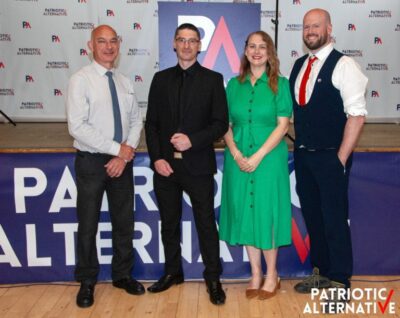
Steve Blake (above, far left) with his PA colleagues Mark Collett, Laura Towler, and Sam Melia
Indeed, Blake was promoted even higher. As well as becoming PA’s Eastern England Regional Organiser he was listed as PA Treasurer when the group applied to the Electoral Commission to register as a political party.
Even more remarkable, a man who not so many years ago had been perhaps Collett’s most detested and underhanded enemy was also made one of the three directors of the limited company that owns PA: the others being its leader Mark Collett and deputy leader Laura Towler.
As already explained, Smith and Blake were the main leaders of the faction that made demands for Collett’s expulsion the centre of their disruption of the BNP. During their campaign, they launched the most vitriolic attacks on him, mixing sensationalised accounts of his genuine failings and misdeeds with outright lies. Both ruthlessly advanced their campaign against him and the party leadership by abusing the trust invested in them when they were granted access to the membership list, administration and Internet communications system. Yet, scarcely a decade later, Collett put the pair into precisely the same positions in his own organisation.
Adding to the mystery, he was under no pressure to do so. PA at the time included plenty of young men with computer skills. Its very loose organisational structure meant that it had no pressing need for bureaucracy. The failure to register it as a political party meant that it had no need for anything other than being able to accept online donations and Bitcoin.
Further, Collett had been at the very centre of the 2007/2008 struggle by the BNP leadership team to understand what the rebels were doing, how they were doing it, and then to stop them. He had personally led the operation to bug Sadie Graham’s phone and had heard or read every scrap of intelligence we could gather.
He attended every meeting we held. Once the pennies dropped and with the benefit of hindsight, he recognised the full significance of gifting Smith oversight of the party’s finances, and of Blake having been coached to win my confidence. He was as convinced as the rest of us that both men were working for outside and hostile agencies.
Nevertheless, he catapulted them to power in PA, over the heads of a wide pool of other candidates, and into a bureaucracy that the organisation didn’t even need.
This is no place to speculate as to his motives, but we must briefly consider how Smith and Blake used that power: With no formal paid membership system at the time, PA classed as a “member” every person that registered online.
This figure tallied well over 20,000, allowing Collett’s deputy Laura Towler to claim that PA was “bigger than the BNP at its height”. This was absurd, since the two simply could not be compared: BNP members all paid conventional membership fees, with thousands joining in real life activities every single week.
PA’s substantial list of email contacts did, however, now give Smith and Blake access to a significant proportion of an entire generation of young, often unusually middle class, nationalist sympathisers. They moved quickly to exploit this.
The pair sent out mass mailings of several bulletins which hammered home key actions expected of PA followers. First was to collect “intelligence” on the far left. Second, to store that intelligence material where the police would not find it.
Smith signed off the first directive in his official capacity as head of PA’s National Administration. Steve Blake green-lighted the second as head of the organisation’s cyber operation. Collett did not countermand or criticise either man; both remained in their posts. In other words, it was official policy.
As such, it was extraordinarily dangerous. PA had been — and continues to be —condemned by opponents as an offshoot in continuity of the now proscribed National Action. Whether this is fair is not at issue here, what matters is that the organisation risks being classified as a terrorist group and outlawed overnight by the Home Secretary.
Collett’s own close involvement with NA at its inception (he was present at and led a martial arts training session at its very first weekend seminar) has been largely ignored by the media and authorities, but it is well-known and is always available to be pulled out and used as justification for a ban. The Smith and Blake directive, however, took a huge leap further down the road to illegality.
Smith’s order that PA members should collect intelligence on far-left opponents was a blatant breach of the Terrorism Act 2000. Section 58 Collection of information sets out that:
(1) A person commits an offence if—
(a) he collects or makes a record of information of a kind likely to be useful to a person committing or preparing an act of terrorism
(b) he possesses a document or record containing information of that kind
None of the possible defences afforded by the legislation could possibly apply to an activist in a ‘far-right’ political grouping widely described by both the media and leading politicians as ‘extremist’ and having several senior members with past links to an organisation already proscribed as terrorist. The maximum sentence for these offences is a staggering 15 years in prison.
As for Blake’s detailed lesson in how to encrypt information and supposedly disguise files behind innocent pictures on a computer, these are a prima facie breach of preparation offenses in the Terrorism Act 2006 (e.g., Sections 1 or 5), as they facilitate evading detection in activities potentially advancing terrorist aims.
It also further breaches the law by encouraging non-compliance with disclosure requirements during terrorism investigations. Under Section 49 of the Regulation of Investigatory Powers Act 2000 (as retained and applied in terror contexts), authorities can issue notices requiring disclosure of encryption keys or access to protected data, with failure to comply carrying a maximum penalty of five years’ imprisonment if linked to terrorism.
The moment I saw the offending bulletin, I wrote a piece explaining just how dangerous it was. Since there was already resentment in PA over the rapid and unexplained promotion of these two compromised outsiders, and because at the time I enjoyed a substantial following on X, my warning went viral and travelled throughout Collett’s organisation.
No action was taken against either Smith or Blake, but it was notable that there was no repeat of the directive, although neither was it in any way countermanded. Both men remained in post, until Kenny Smith split away from PA to form his Homeland Party, amid much mutual hostility.
Blake, contrary to expectations, stayed ‘loyal’ to Collett and remained in PA. Reporting his death in August 2025, Collett posted on Telegram that:
“It is with great sadness that we announce the death of Steve Blake, which occurred early this week. Steve was a beloved member of our community and had served as our Treasurer since 2022 and as Regional Organiser for Eastern Region before that. Steve was many things to many people – a friend, a comrade and a mentor. He had a huge impact on the lives of everyone he met, and he will be greatly missed by us all. Our thoughts are with his family at this difficult time.”
Curiously, Kenny Smith also posted a fulsome tribute as well.
Does the fact that no action has so far been taken against anyone over the Smith/Blake directive mean that my warning was inaccurate? Not at all, a solicitor with extensive experience in this field promptly confirmed that my analysis of the law was correct.
Possibly, my warning and the widespread alarm it prompted convinced those behind the trap that no-one would now be stupid enough to walk into it or perhaps springing it in these circumstances would have proved to too many people that I was right and that Smith and Blake were indeed working for the State.
Furthermore, the whole PA honeytrap is still ongoing. By the very nature of such operations, the longer it lasts, the more victims will be caught before it’s snapped shut.
Groups like PA resemble a bath with the taps on and the plug out. While relatively small at any one time, the total number of people who pass through it is quite substantial. Tens of thousands of individuals — many of them middle class teenagers who have already gone on to further education and a variety of career paths — are therefore in the records which Blake held, and no doubt passed on to his handlers (just as the Smith/Blake faction of 2007 leaked the BNP membership list).
Each of those individuals is now vulnerable — not so much to legal sanction — as to blackmail by security service operatives: “Play ball with us or we’ll leak your past PA membership, and your career will be over.”
For maximum effect, of course, PA needs to be — not just demonised (as it already is) — but declared illegal. The Home Secretary can order this at any time, although the most likely moment is when external factors such as inter-ethnic tensions or the decision to outlaw another Islamist group makes it useful to the State to have a white organisation to proscribe at the same time, by way of showing ‘balance’.
Whenever that happens, it will be convenient to the powers-that-be that they can act against PA, without inconveniencing or exposing one of their most effective agents. So convenient, indeed, that one must harbour doubt as to whether Blake is truly dead, or whether the announcement by Collett (and, if necessary, even evidence of a funeral) is a shrewd cover for the retirement of a security services operative.
There is, after all, a very good case to be made that this “beloved member of our community” did in fact spend a quarter of a century undercover in the nationalist movement, doing immense damage during his sordid career. If the hammer of proscription is planned for PA, why would they not get their man out once his work is done?
Or, of course, he may genuinely have died. Single men who live alone in general, and homosexuals in particular, have much shorter life expectancy than normal, and living under the almost unimaginable strain of being an agent embedded among people whose ideas one has come to loath must surely be very bad for the health at all.
Whichever it is, the man has now gone, and nationalists all over are somewhat safer for that.
Steve Blake tries for the Captain Picard look hoping to entice Royal Shakespeare thespians into his bed